
The Rise of Agentic AI in Software Testing: What QA Engineers Need to Know
The software testing landscape is undergoing a revolutionary transformation. While traditional automation tools have streamlined many QA processes, a new generation of intelligent systems is emerging that promises to fundamentally change how we approach quality assurance. Software testing is on the cusp of a new era. Traditional automation and AI tools have optimized various aspects of QA, but a new generation of intelligent approach — known as Agentic AI — is now enhancing testing with unprecedented autonomy and adaptability.
For QA engineers and teams using platforms like Workflowly to manage frontend testing workflows, understanding agentic AI isn’t just about keeping up with trends—it’s about preparing for the future of autonomous quality assurance.
Understanding Agentic AI: Beyond Traditional Automation
Agentic AI refers to intelligent agents — powered by large language models and advanced decision-making algorithms — that can plan, act, and learn independently. Unlike conventional AI tools that automate individual tasks, Agentic AI happens when autonomous “agents” make decisions, plan actions, or solve problems independently, with little to no human interaction. Agentic AI is goal-oriented and focused on outcomes.
Key Capabilities That Set Agentic AI Apart:
- Multi-step Autonomy: Unlike conventional AI tools that automate individual steps like test script generation or data entry, agentic systems bring multi-step autonomy.
- Decision-Making: AI tools are increasingly being trusted to optimize test coverage and maintenance.
- Self-Healing: If a test fails, the agent might automatically trigger additional diagnostic tests to gather more detailed information about the failure’s cause or even try to fix trivial issues automatically.
- Continuous Learning: The agent continuously learns from its experiences and refines itself. This hypothetical scenario isn’t as far-fetched as it might seem.
The Current State: Market Growth and Adoption
The numbers tell a compelling story about the rapid adoption of agentic AI in testing. Gartner estimates that by 2028, 33% of enterprise software apps will be outfitted with agentic AI capabilities (compared to near-zero in 2024), automating perhaps 15% of mundane work decisions.
Market Statistics:
- The global AI agent market is valued at $7.38 billion in 2025, nearly doubling from $3.7 billion in 2023. It’s projected to grow to $103.6 billion by 2032. Business process automation leads adoption, with 64% of AI agent deployments focused on automating workflows across support, HR, sales ops, and admin tasks.
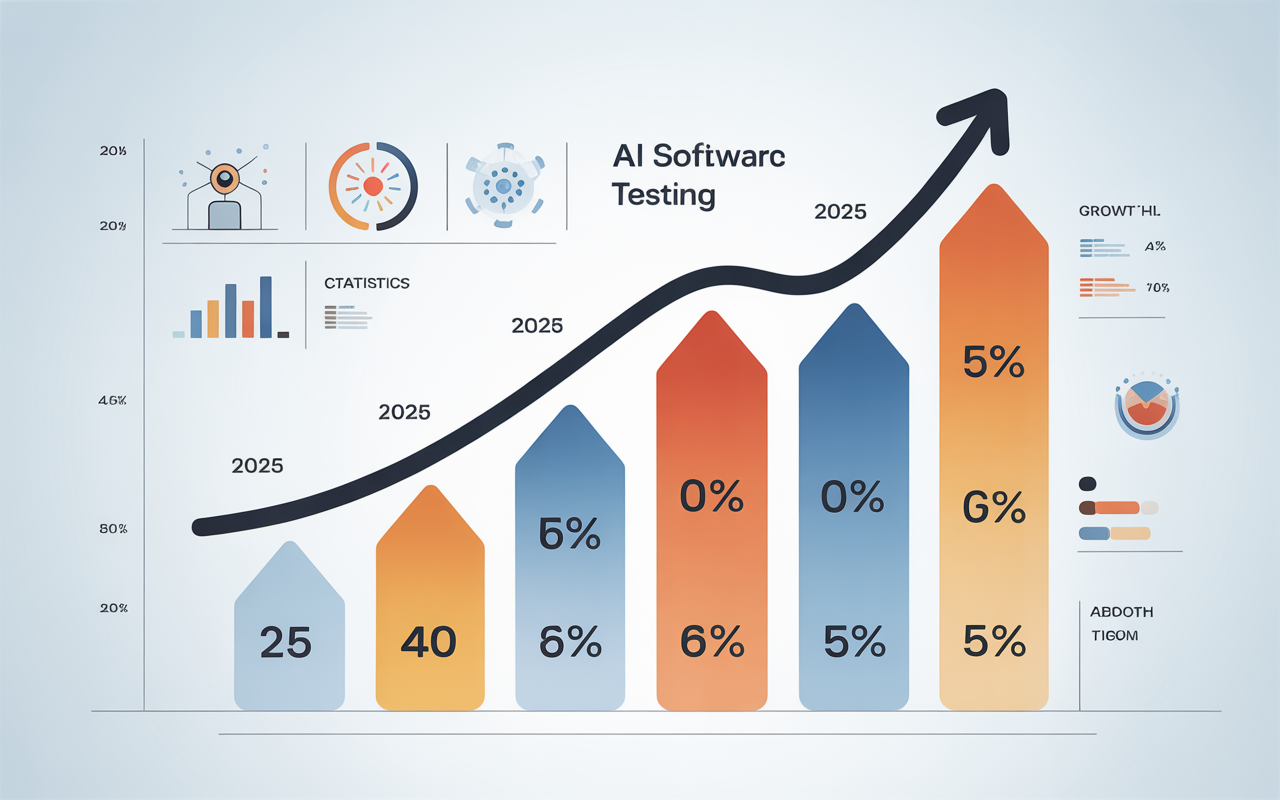
- 40% of the total IT budget will be spent on various types of AI testing applications in 2025, as IDC.com states. With their help, QA teams can automate up to 70% of routine tasks.
- By 2025, 70% of enterprises are projected to adopt Agentic AI in testing to keep pace with DevOps demands, while Gartner predicts 15% of daily work decisions will be made autonomously by AI agents by 2028—up from zero in 2024.
Learn more about AI testing trends in this comprehensive guide: AI in Software Testing: 5 Trends of 2025
Real-World Applications: How Agentic AI Transforms Testing Workflows
Intelligent Test Prioritization
Instead of relying on pre-scripted tests and rigid schedules, this Agentic AI system would perform the following actions: Prioritization: The agent analyzes recent code changes and feature releases, prioritizing regression tests based on the risk associated with each modification.
Dynamic Test Generation and Maintenance
Modern agentic AI systems excel at creating and maintaining tests with minimal human intervention:
-
Automated Test Creation: Tools like Testim and Functionize use generative AI to auto-create test cases by analyzing user journeys and requirements. For example: A healthcare app’s patient onboarding flow can be tested across 100+ scenarios (e.g., data validation, error handling) in minutes. Result: Teams reduce test design time by 50%, freeing engineers for high-value tasks like exploratory testing.
-
Self-Healing Scripts: Traditional scripts break with minor UI updates (e.g., button ID changes). Agentic AI solves this with: Visual Testing: Tools like Applitools validate UI elements using image recognition, not brittle code. Dynamic Locators: AI tracks elements based on context (e.g., “Submit” button near a login form). Impact: Maintenance costs drop by 40%, ensuring CI/CD pipelines run uninterrupted.
For practical implementation guidance, check out this detailed tutorial: Top 10 Agentic AI Tools for Quality Assurance Automation in 2025
Predictive Analytics in Testing
Agentic systems analyze code commits, past defects, and user behavior to predict risks. For instance: A fintech app’s transaction module is flagged as high-risk after a backend update. AI prioritizes testing this module, catching 95% of critical bugs pre-launch.
Essential Tools and Frameworks for 2025
Leading Agentic AI Testing Platforms
1. Advanced Visual Testing Tools
– Applitools: Pioneer in visual AI testing across browsers and devices
– Testim: Machine learning-powered test creation and self-healing capabilities
– AskUI: Leading autonomous UI interaction across desktop, browser, and mobile platforms
2. Open-Source Agentic Frameworks
AutoGPT and LLM Agent Frameworks – Open-source initiatives such as AutoGPT, BabyAGI, and LangChain have made the concept of autonomous LLM agents mainstream. These frameworks encapsulate GPT-4 (and its successors) in loops of tool-using and planning, enabling the model to specify goals and perform actions step-by-step. For example, AutoGPT may be told to “test this web app” and will try to decompose tasks, look up appropriate documentation, and execute code.
3. Enterprise Solutions
Cognition’s Devin – Debuting in 2024, Devin is marketed as the first AI software engineer. It has the ability to do engineering work on its own like developing apps, debugging, and even learning new technologies by reading documents. For QA, Devin and agents like it can write tests automatically or debug code automatically, essentially playing the role of a full-time QA engineer.
Explore additional frameworks: Top 5 Agentic AI Frameworks to Watch in 2025
Actionable Implementation Strategies
1. Start with Pilot Projects
Begin your agentic AI journey by identifying high-impact, low-risk areas:
– Regression testing for stable applications
– API testing with predictable endpoints
– Visual validation for UI components
2. Build Internal Capabilities
Invest in Skills Development: Equip your team with knowledge in AI, automation, and DevOps to stay competitive. Hybrid roles will be the foundation of future testing teams.
3. Integrate with Existing Workflows
Unify Testing with DevOps and SRE: Break down silos and integrate quality assurance into every phase of delivery for faster feedback and operational stability.
4. Focus on Human-AI Collaboration
About 71% of users prefer a human-in-the-loop setup, especially for high-stakes decisions, ensuring safety and accountability in AI-driven tasks.
Watch this practical implementation guide: LambdaTest YouTube Channel for hands-on tutorials on AI-powered testing tools.
Challenges and Considerations
Technical Challenges
Over 40% of agentic AI projects will be canceled by the end of 2027, due to escalating costs, unclear business value or inadequate risk controls, according to Gartner.
Key considerations include:
– Cost Management: Initial investment in a comprehensive Agentic AI Testing System could range from $50M to $100M+.
– Skill Gap: Most enterprises lack the experience and resources to become cutting-edge AI product companies.
– Change Management: Adapting existing processes to accommodate autonomous systems
Best Practices for Success
- Define Clear Objectives: In this early stage, Gartner recommends agentic AI only be pursued where it delivers clear value or ROI.
- Maintain Oversight: Regardless of how autonomous AI becomes, it’s our opinion that a certain level of human oversight will always be required.
- Plan for Integration: Integrating agents into legacy systems can be technically complex, often disrupting workflows and requiring costly modifications. In many cases, rethinking workflows with agentic AI from the ground up is the ideal path to successful implementation.
Read more about implementation challenges: Agentic AI is Here — But Is Your Strategy for Testing AI Agents Ready?

The Future of QA: Preparing for What’s Next
Emerging Trends to Watch
App Complexity: Microservices vs. monolithic architectures. User Behavior: Prioritizing features with high traffic or revenue impact.
Career Development for QA Engineers
The U.S. Bureau of Labor Statistics estimates that employment opportunities for software developers and testers will increase “much faster” than the average rate until 2033, in part due to the way AI is fueling growth in digital products.
Skills to develop:
– AI/ML fundamentals
– Data analysis and interpretation
– Strategic test planning
– Cross-functional collaboration
Expand your knowledge with these educational resources: Top Automation Testing YouTube Channels to Follow In 2025
Conclusion: Embracing the Agentic Future
As Gartner and industry trends indicate, agentic AI testing is not hype — it’s the next reality. For QA engineers and teams, the question isn’t whether agentic AI will transform testing—it’s how quickly you can adapt and leverage these powerful new capabilities.
The shift toward agentic AI represents more than just technological advancement; it’s a fundamental change in how we approach quality assurance. By understanding these systems, implementing them thoughtfully, and preparing teams for this transition, QA engineers can position themselves at the forefront of this transformation.
Ready to explore agentic AI for your testing workflows? Start by evaluating your current processes, identifying automation opportunities, and building the skills needed to thrive in this AI-driven future. The testing revolution is here—make sure you’re ready to lead it.
For more insights on AI-powered testing and workflow optimization, explore Workflowly’s platform designed specifically for QA engineers to create and manage sophisticated frontend testing workflows with cutting-edge AI capabilities.
Leave a Reply